Service 03 / 11
Production-grade Next.js with the App Router, React Server Components and edge rendering — engineered for top Core Web Vitals and search visibility.
Overview
What you get.
- Blazing fast
- SEO ready
- Edge optimized
Next.js gives you the best of static and dynamic: pages that are pre-rendered for speed and SEO, with server-side logic, streaming and incremental updates where they matter.
We architect around the App Router — server components by default, client components only where interactivity demands it — so the JavaScript your visitors download stays small and your pages stay quick.
Next.js is not just a faster React. Routing, caching, image handling, metadata and data fetching are first-class, which removes entire categories of glue code and configuration your team would otherwise maintain.
We pay particular attention to caching strategy. Choosing what is static, what is cached and revalidated, and what must be dynamic is the difference between a site that feels instant at 10 visitors and one that still feels instant at 10,000.
Why it matters
The problem we solve.
Speed is a ranking and revenue factor
Faster first paint and better Core Web Vitals improve both search visibility and the share of visitors who stay and convert.
One codebase, front to back
Pages, API routes and server actions live together in TypeScript, which shortens delivery and reduces integration bugs.
SEO without workarounds
Server-rendered HTML is immediately readable by crawlers and social previews — no prerender hacks.
A large, stable ecosystem
Backed by Vercel and widely adopted, so hiring, libraries and long-term support are low risk.
Scope of work
What’s included.
App Router architecture
Nested layouts, route groups, parallel and intercepting routes.
Rendering strategy
SSG, SSR, ISR and streaming chosen per route for the best speed/freshness trade-off.
Server Actions & Route Handlers
Type-safe mutations and REST/webhook endpoints without a separate server.
Authentication & authorisation
Session handling, OAuth/SSO, role-based access and middleware guards.
Image, font & script optimisation
next/image, next/font and script strategies tuned for LCP and CLS.
SEO & i18n
Metadata API, dynamic sitemaps, OG images and localised routing.
Ideal clients
Who this is for.
Content-heavy sites
Publishers, marketplaces and directories with thousands of pages that need to be fast and indexable.
SaaS products
Marketing site plus authenticated app in one framework with shared components.
Ecommerce brands
Custom storefronts where speed and SEO directly drive revenue.
Teams migrating from CRA or Pages Router
Projects held back by slow builds, poor SEO or an aging architecture.
How the project runs
Our process.
Transparent milestones, weekly demos and one point of contact from kickoff to launch.
- 01
Architecture review
Data sources, caching layers, rendering modes and hosting model are decided up front.
- 02
Foundation
Monorepo/TypeScript strict config, linting, testing and CI with preview deployments.
- 03
Feature build
Vertical slices — UI, data fetching and API — delivered in weekly demoable increments.
- 04
Data & caching
Fetch caching, revalidation tags and edge caching tuned against real traffic patterns.
- 05
Testing
Unit (Vitest), integration and end-to-end (Playwright) coverage on critical flows.
- 06
Deploy & observe
Zero-downtime release, Web Vitals RUM, error tracking and alerts.
Quality bar
Standards we hold.
Server-first by default
Client components only where interactivity requires, keeping bundles lean.
Strict TypeScript
End-to-end types from database to component, with no `any` leaking through.
Preview on every PR
Each change gets its own deployed URL so design and product review real software.
Observability built in
Real-user Web Vitals, error tracking and structured logs from the first deploy.
Tooling
Technology stack.
Framework
Data
Platform
Quality
Glossary
Terms we use.
- RSC (Server Components)
- React components that render on the server and ship no client JavaScript.
- ISR
- Incremental static regeneration — static pages refreshed in the background on a schedule or on demand.
- Streaming / Suspense
- Sending HTML in chunks so users see content before the whole page is ready.
- Edge runtime
- Code executed on servers geographically close to the user for low latency.
- Hydration
- Attaching React's interactivity to server-rendered HTML.
- Core Web Vitals
- Google's LCP, INP and CLS metrics for loading, responsiveness and visual stability.
- Route Handler
- A server endpoint defined inside the App Router, used for APIs and webhooks.
- Middleware
- Code that runs before a request completes — used for auth, redirects and localisation.
FAQ
Common questions.
Can you migrate our existing site to Next.js?
Yes. We migrate incrementally — preserving URLs, redirects and rankings — so there's no big-bang risk.
Next.js or a plain React SPA?
If SEO, first-load speed or content matters, Next.js. For logged-in internal tools, a SPA can be enough; we'll tell you honestly.
Where will it be hosted?
Typically Vercel, but we also deploy to AWS, Docker/Kubernetes or your own infrastructure.
Do you use the App Router or Pages Router?
App Router for all new work. For existing Pages Router projects we migrate route by route, since both can coexist.
How do you handle SEO on dynamic content?
Per-page metadata via the Metadata API, dynamic sitemaps, canonical URLs, structured data and Open Graph images generated at build or request time.
Can you integrate our existing backend or CMS?
Yes. Next.js sits comfortably in front of REST, GraphQL, headless CMS and legacy APIs, with caching layered in so slow upstreams don't slow your pages.
Working together
How we engage.
Fixed-scope project
A defined scope, timeline and price agreed after discovery. Best for launches and rebuilds with clear requirements.
Monthly retainer
A dedicated block of senior time each month for continuous delivery, iteration and support.
Audit & advisory
A short, focused engagement that reviews what you have and hands you a prioritised plan to act on.
What to expect
Kickoff
A 45–60 minute call to understand goals, audience, constraints and timeline.
Written proposal
Scope, milestones, deliverables and pricing within a few working days of the call.
Weekly rhythm
A short demo and written update every week so there are never surprises.
Your input
One decision-maker, timely feedback and access to brand assets, content and accounts.
Ready for next.js development?
Book a callOur projects
Proof, not promises.
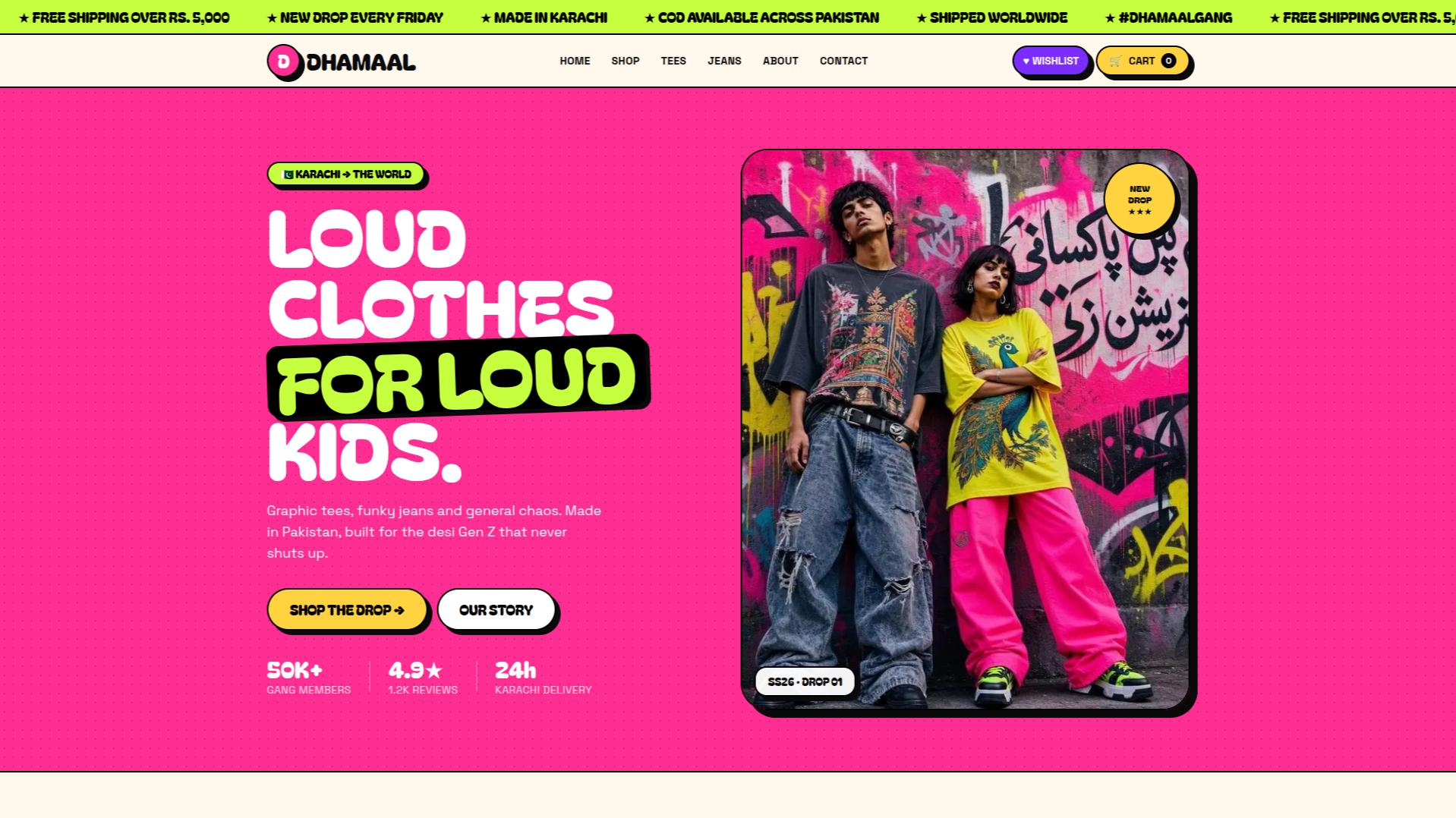
Dhamaal
Loud streetwear ecommerce — graphic tees & jeans from Karachi

Virra
Clothing brand ecommerce — Dresses, Trousers, and Accessories and more

Mehr
Pakistani fashion ecommerce — premium fabrics, ready-to-wear and custom tailoring