Service 11 / 11
Core Web Vitals, Lighthouse and real-user audits that turn a slow site into a fast one — with measurable gains in conversion and rankings.
Overview
What you get.
- Lighthouse 95+
- CWV pass
- Real user gains
Speed is a revenue lever: slower pages lose visitors, rankings and sales. We measure with both lab tools (Lighthouse) and field data (CrUX, RUM) so we fix what real users actually experience.
Each fix is prioritised by impact versus effort and verified with before/after metrics — no guesswork and no vanity scores.
Performance work fails when it's treated as a score chase. A perfect lab score on a fast laptop means little if your real customers are on mid-range phones on patchy networks. We prioritise field data and your most valuable pages.
We also address the usual culprits that engineering alone can't fix — heavy marketing tags, unoptimised hero media and third-party widgets — and give your team practical guidelines to keep them in check.
Why it matters
The problem we solve.
Speed influences conversion
Faster pages keep visitors engaged and reduce bounce, particularly on mobile.
Core Web Vitals affect search
Google uses real-user experience signals as part of page experience.
Slow sites cost more to run
Heavy pages and inefficient queries raise bandwidth and server bills.
Accessibility and speed overlap
Lean, semantic pages perform better for people on slow devices and connections.
Scope of work
What’s included.
Performance audit
Lighthouse, WebPageTest, CrUX and RUM review with a ranked fix list.
LCP / INP / CLS fixes
Hero images, render-blocking resources, long tasks and layout shifts.
Bundle optimisation
Code splitting, tree shaking, dependency pruning and lazy loading.
Image & font strategy
AVIF/WebP, responsive srcset, preloading and font subsetting.
Caching & CDN
HTTP caching, edge caching, compression and TTFB reduction.
Backend & database
Query tuning, indexing and API response optimisation.
Ideal clients
Who this is for.
Ecommerce stores
Shops losing sales to slow product pages and checkout.
Publishers and content sites
Sites with ad scripts, large images and poor CLS.
SaaS marketing sites
Teams seeing poor Lighthouse and vitals after years of additions.
Web apps
Dashboards and apps with slow interactions and large bundles.
How the project runs
Our process.
Transparent milestones, weekly demos and one point of contact from kickoff to launch.
- 01
Measure
Baseline lab and field metrics across key templates and devices.
- 02
Diagnose
Waterfalls, flame charts and bundle analysis to find the root causes.
- 03
Prioritise
Fixes ranked by impact vs. effort with expected gains.
- 04
Implement
Changes shipped behind preview deployments and verified.
- 05
Verify
Before/after comparison on lab and real-user data.
- 06
Guard
Performance budgets and CI checks to prevent regressions.
Quality bar
Standards we hold.
Measured before and after
Every optimisation is verified with data.
Real-user first
Field metrics guide priorities over synthetic scores.
No breakage
Visual and functional regression checks ship with every change.
Sustainable gains
Budgets and CI gates prevent performance from sliding back.
Tooling
Technology stack.
Measure
Monitor
Delivery
Build
Glossary
Terms we use.
- LCP
- Largest Contentful Paint — how fast the main content appears (target < 2.5 s).
- INP
- Interaction to Next Paint — responsiveness to input (target < 200 ms).
- CLS
- Cumulative Layout Shift — visual stability (target < 0.1).
- TTFB
- Time to first byte — server and network response time.
- Critical rendering path
- The steps the browser takes to display the first pixels.
- Performance budget
- A limit on page weight or timings enforced in CI.
- Lazy loading
- Delaying off-screen images and scripts until they're needed.
- Render-blocking resource
- CSS or JS that prevents the browser from displaying content until it loads.
FAQ
Common questions.
What scores can you guarantee?
We target Lighthouse 95+ and passing Core Web Vitals on key templates, but real results depend on your stack and third-party scripts — we set targets after the audit.
Will you rebuild the site?
Rarely. Most gains come from targeted fixes; we only recommend a rebuild if the architecture is the bottleneck.
How soon will rankings improve?
Field data takes about 28 days to update in CrUX; ranking effects follow over the following weeks.
What deliverables do I get?
An audit report with findings and priorities, implemented fixes, before/after metrics and guidance to keep scores healthy.
Do third-party scripts matter?
Hugely. Tag managers, chat widgets and trackers are often the biggest cost; we audit, defer or replace the worst offenders.
Can you optimise a site you didn't build?
Yes, across most stacks — Next.js, React, WordPress, Shopify and custom builds.
Working together
How we engage.
Fixed-scope project
A defined scope, timeline and price agreed after discovery. Best for launches and rebuilds with clear requirements.
Monthly retainer
A dedicated block of senior time each month for continuous delivery, iteration and support.
Audit & advisory
A short, focused engagement that reviews what you have and hands you a prioritised plan to act on.
What to expect
Kickoff
A 45–60 minute call to understand goals, audience, constraints and timeline.
Written proposal
Scope, milestones, deliverables and pricing within a few working days of the call.
Weekly rhythm
A short demo and written update every week so there are never surprises.
Your input
One decision-maker, timely feedback and access to brand assets, content and accounts.
Ready for performance optimization?
Book a callOur projects
Proof, not promises.
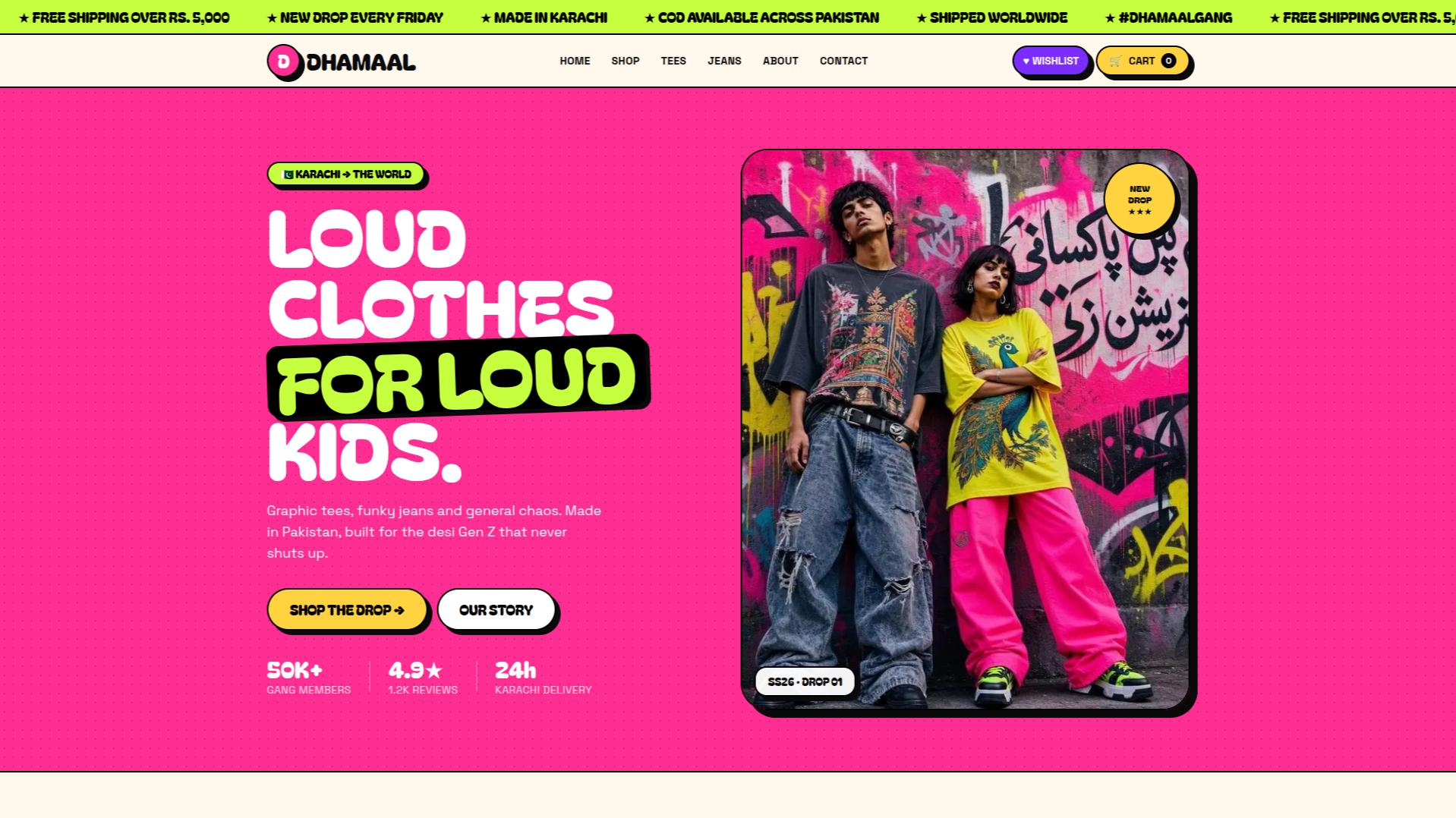
Dhamaal
Loud streetwear ecommerce — graphic tees & jeans from Karachi

Virra
Clothing brand ecommerce — Dresses, Trousers, and Accessories and more

Mehr
Pakistani fashion ecommerce — premium fabrics, ready-to-wear and custom tailoring